Learning to race for a positive outcome: ABC’s
Almost every Monday morning I run with some friends. We cover a vast array of conversation topics and running terrain. Today part of our chatter focused on weekend racing that one of the ladies had competed in. Another of the ladies’ three daughters also raced. Whilst some nerves and pre-race anxiety were discussed, I was most interested in the positivity with which the race performances and subsequent outcomes were being viewed.
Dealing with setbacks, failure, or difficulties such as pre-race or pre-performance nerves are part of life. If you want to understand a little more about why you think you might or might not do well, this little post can give you a few ideas. In psychology of sport (and in other psychotherapy or counselling situations) an ABC model is applied to how you think and feel and what then happens. I have seen a number of different explanations of the model using different A words, different B words and even different C words depending on the context. To illustrate, I’ll describe a commonly followed model in psychology of sport with other vocabulary options in brackets.
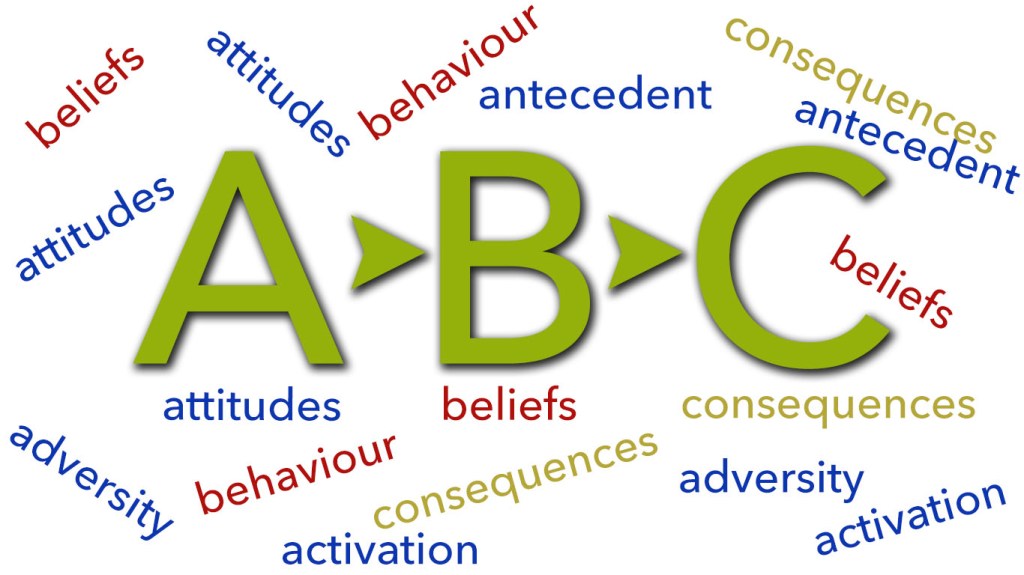
A: Attitude towards the situation (Antecedent, Activating event, Adversity). This is often what happens first or before the event, or the event itself, or the underlying attitude you hold based on previous experiences and your understanding of yourself, i.e., “I’ve always done well and find that I excel in a race environment.”
B: Beliefs about your ability (Behaviour). Your beliefs are often described by the degree, clarity, or intensity of your thoughts about the situation and you being part of that situation, i.e., “I 100% believe I am going to win.” Your behaviour results from your belief in your ability, i.e., you systemically follow your pre-race rituals, you complete each task as it comes and you remain in control.
C: Consequences of your attitude, beliefs, and behaviour. The consequences often occur during or after and because of your performance or event taking place. These can be both physical and emotional, i.e., resulting from your 100% belief that you were going to win, you went all out with your performance, followed your plan and came home with the gold, beaming from ear to ear.
The best thing about this model is that you can change the consequences by moderating or adjusting your attitudes and beliefs, this leads to different behaviour and by default, to different outcomes.
Going back to this morning’s chat, I’ll describe the very positive outcomes my friends described. All the people were racing in a duathlon (run, cycle and run) event that allows bicycle drafting. This is a form of cycle racing where groups of riders benefit from the draft created by riding in group formation as compared to riding individually or solo, like in a cycling time trial.
Fiona saw her race as something new; an experience that she had no benchmark to base her expectations on. Her attitude was to be open-minded, a bit conservative and ‘see how it goes’. Her belief in herself and her ability to be part of the event was based on her previous experience in multi-discipline racing and the consequences were that she thoroughly enjoyed the (new to her) in race cycle-drafting component and felt that she was able to hold her own. She has grown in confidence and tried something that was previously outside of her comfort zone. Fiona’s result has allowed her to qualify for a European Championship.
Think about how different Fiona’s outcome might have been if her attitude had been to never try anything new or different.
Catriona’s three daughters’ (whom I have not spoken to about the event) experiences were described to me by their Mum. Two of them were a bit nervous, and the other not at all. The two described as being a bit nervous might have been so based on their previous podium success in multi-discipline events and therefore based their expectations on achieving a similarly good result and the associated peer pressure. Catriona’s other daughter has not experienced a podium placement and perhaps holds no expectations of such. From my listening perspective, the unconditional family support offered to all three girls leads me to believe that the only consequence of racing or participating for them is positive re-enforcement of their best efforts regardless of the perceived achievement success. Two of the girls achieved a podium place and the third did not. All three returned home happy, supported, and loved.
Think about the consequences for the girls if their attitude to racing was conditionally based on gaining family support or love by achieving a podium spot.
Whilst the alternatives here might seem extreme, they are not so far-fetched as to be ridiculous. We will often misconstrue our thoughts as reality and this can lead us into believing we can’t achieve something. Check the evidence for behind your beliefs and begin to redefine your attitudes for new, better and different outcomes.
 HOME
HOME 
Leave a comment