If your sport is a summer sport, your competition season has begun and all being well will continue until the early autumn. Being prepared to compete, participate and perform is a big topic amongst athletes. Am I ready? How do I know I’m ready? Is everyone else except me ready?
If you are new to competition or taking part in events, it’s difficult to know if you are ready. In your stream of consciousness are you unconsciously incompetent, consciously incompetent, consciously competent or unconsciously competent.
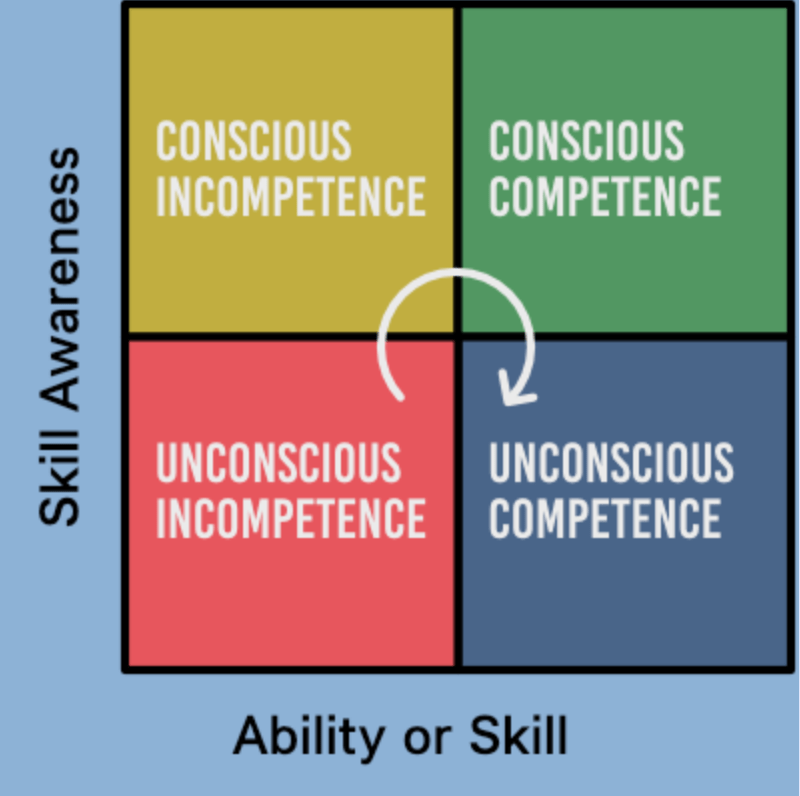
This model of learning is often attributed to Martin M Broadwell. It is often illustrated as a pyramid or hierarchy of learning. If you are honest with yourself, you’ll come to realise where you are on your journey of competence within your sport. Understanding where you are with relation to your level of competency will inform you of your readiness to perform or compete or participate. This doesn’t mean that you have to know everything about your sport, your self, your competitors, the event.. However, what it helps you to identify is where the gaps are in your competence. In the simplest of terms, if you entered a swimming event and know that you can’t swim, you are consciously incompetent. You know that you need to learn to swim and along the way to getting to the start of your event you will want to be consciously competent at the very least (to avoid drowning!).
Having achieved conscious competence (usually a basic level of skill that allows you to safely complete the task and requires you to concentrate fully whilst doing it), you might feel confident to participate or compete, but what more can you do be prepared?
If you don’t know what the organisation and logistics around your event are going to be, find out.
If you don’t know who else will be there, find out.
If you need help to get there (not only physically and logistically, but emotionally), get that help.
Make a pre-event plan for the days and weeks prior to competing or participating. Make an event day plan. You can use a diary or wall planner, a mind map, a piece of paper, a voice memo – anything that works for you. Work back from the ‘finish line’ or end of your event right until ‘the here and now’. You can be as detailed or broad as you like and this helps you to visualise what might happen and how you want things to happen. Next week we can look at more detail on how to do this…
 HOME
HOME 
Leave a comment